Louisana passes resolution aimed at military justice reform
The military justice system exists to uphold order, discipline, and accountability. But its legitimacy depends on something even more fundamental: the assurance that every allegation will be investigated fairly, every relevant fact will be considered, and every accused service member will receive meaningful due process.
When that assurance breaks down, the damage extends far beyond a single court-martial. It can destroy careers, separate families, strip veterans of benefits, and leave permanent marks on people who may never have been convicted in a civilian court.
That is why a resolution passed on August 15 by the Louisiana Republican State Central Committee deserves serious attention. Titled To Defend the Honor of America’s War Fighters and Secure Justice for the Wrongfully Accused Under the UCMJ, the resolution calls for an independent military innocence and conviction integrity review board, stronger due process protections, targeted presidential clemency, and a pathway to restore what exonerated service members lost.
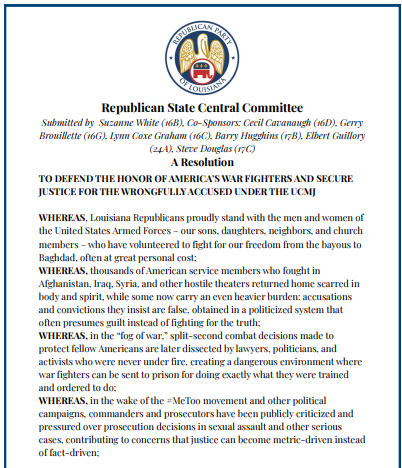
First page of resolution
As a Navy veteran and the host of S.O.S. (Stories of Service), I have spent years listening to service members, veterans, whistleblowers, and military families describe what happens when institutions prioritize protecting themselves over protecting the truth. This resolution does not settle every disputed case, nor should it. What it does is acknowledge that credible claims of wrongful conviction deserve independent examination rather than institutional silence.
How Pressure Can Distort Military Justice
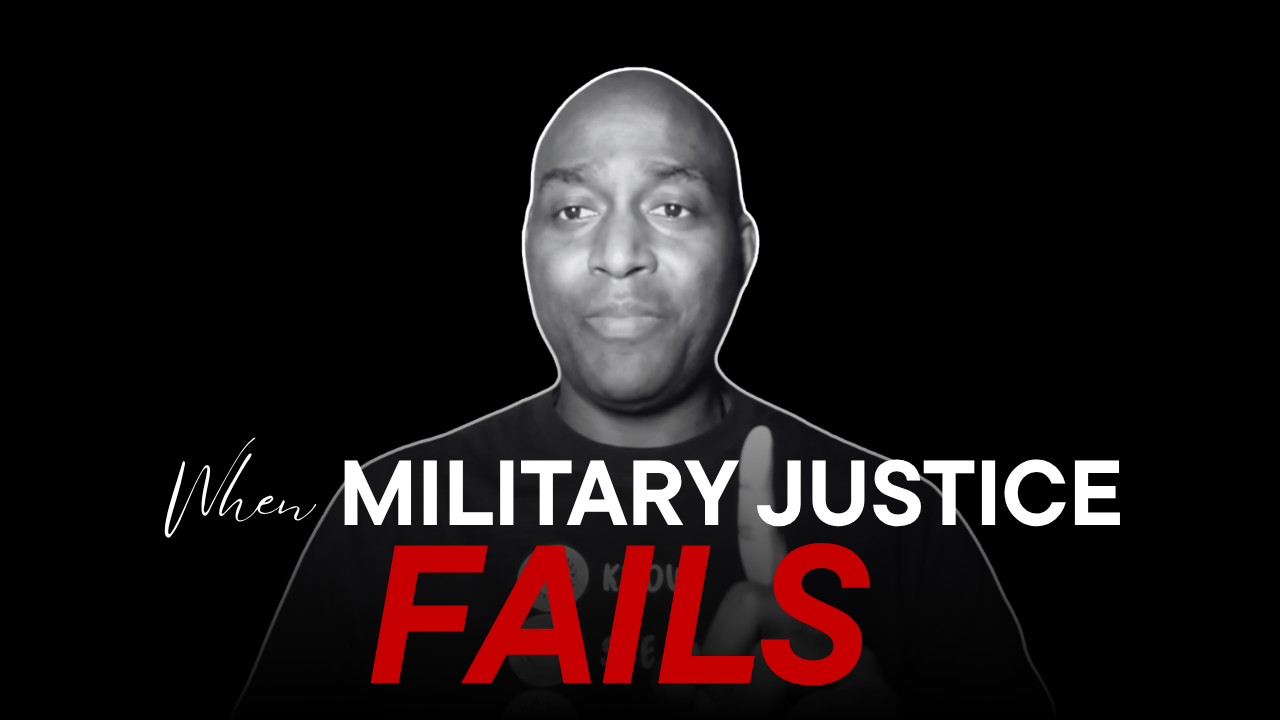
On Tell It Like It Is with James Thomas, former U.S. Navy Commander, Naval Academy graduate, and Louisiana native Arvis Owens traced the issue back to political and institutional pressure to increase sexual-assault prosecutions and convictions.
Sexual assault is a serious crime. Survivors deserve to be heard, protected, and treated with dignity. Offenders must be held accountable. None of that requires abandoning the presumption of innocence or accepting weak investigations. In fact, a process driven by facts rather than predetermined outcomes better serves genuine victims and the accused.
Owens argues that policies intended to encourage reporting also created benefits that could, in rare cases, provide incentives for false allegations. He described an environment in which commanders faced pressure to produce measurable results and investigators sometimes failed to pursue or disclose evidence favorable to the defense.
These are serious allegations that require evidence, not reflexive acceptance or dismissal. That is precisely why independent review matters.
Why Public Recognition Matters
Owens says he was falsely accused and wrongfully convicted in 2013. After beginning to speak publicly, he heard from service members across the Army, Navy, Air Force, Marine Corps, and Coast Guard who reported similar experiences.
For years, he said, some political figures privately expressed support but hesitated to speak publicly. The Louisiana resolution changed that dynamic by putting institutional support in writing.
That distinction matters. Private sympathy may comfort someone, but it does not create accountability. A formal resolution tells Congress, the Department of Defense, and the President that alleged failures within the military justice system warrant public scrutiny and corrective action.
The resolution gained momentum after Owens spoke to a Louisiana Republican group in July. According to Owens, a former Marine serving as a Senate staffer stood during the presentation and said he had witnessed dozens of similar cases. Other veterans then shared their own experiences. The committee ultimately supported the resolution unanimously.
This is only one state political organization, and a resolution does not change federal law or overturn a conviction. But it can give reformers a foundation from which to seek broader, bipartisan action.
The Case for an Independent Review Board
The resolution’s central proposal is an independent military innocence and conviction integrity review board empowered to examine contested UCMJ cases and recommend appropriate remedies, including new trials, expungement, setting aside convictions, or clemency.
Owens contends that the military cannot credibly investigate every alleged failure of its own system. The people and organizations involved may face reputational pressure or have an interest in defending earlier decisions. An independent, civilian-led body could examine evidence without the same chain-of-command pressures.
During the interview, Owens described cases in which potentially exculpatory recordings or witnesses were allegedly withheld from court-martial panels. He also discussed his own case, claiming that panel members later wrote letters questioning their decision, only for those letters initially to go missing before being located during appellate proceedings.
These accounts should be tested through an impartial process. The purpose of an independent board would not be to presume every conviction wrongful. It would be to ensure that credible claims receive a fair, transparent, and evidence-based review.
Due Process Must Extend Beyond the Courtroom
The resolution also calls for unanimous verdicts in serious cases, full access to exculpatory and impeachment evidence, stronger appellate protections, and limits on abusive titling and indexing practices.
Titling and indexing can place a person’s name and identifying information in law-enforcement databases based on an investigation, even when the individual was never tried or convicted. Owens explained that such records can affect employment, professional licensing, education, volunteer opportunities, housing, and personal relationships for decades.
This is an area the public rarely sees. A service member may avoid a court-martial or even be cleared of charges yet continue to carry an administrative shadow that looks like guilt to employers and other institutions. Any meaningful military justice reform must address these collateral consequences and provide a practical way to correct inaccurate or unjust records.
Exoneration Is Only the Beginning
Overturning a wrongful conviction does not automatically make a veteran whole. Years of lost pay, reduced rank, damaged benefits, family separation, housing instability, and reputational harm cannot be erased with a single legal order.
The Louisiana resolution recognizes this reality by proposing restoration of rank, pay, and veterans’ benefits where appropriate, along with removal of unjust registry or titling entries and access to legal and mental-health support.
Public harm also requires public correction. When the government brands someone guilty and that judgment is later proven wrong, quietly changing a record is not enough. Exonerated service members deserve an official acknowledgment that allows families, employers, and communities to understand what happened.
Better Justice for Everyone
Military justice reform should never be framed as a choice between supporting survivors and protecting the wrongfully accused. A credible system must do both.
Owens supports removing these investigations from command influence and placing them under fully civilian leadership. Whether lawmakers adopt that exact approach or another model, three principles should guide reform: neutral language before facts are established, thorough investigations that consider all evidence, and policies that do not predetermine outcomes.
The Louisiana resolution is not the finish line. It is an invitation to Congress, defense leaders, and the White House to examine whether current safeguards are adequate—and to act if they are not.
For me, the issue comes down to integrity. We cannot ask Americans to trust the military justice system simply because it belongs to the military. Trust must be earned through transparency, fairness, accountability, and the courage to correct mistakes.
Genuine victims deserve justice. Those who commit crimes deserve accountability. And service members who defend the Constitution deserve its protections, including due process and a meaningful path to correct a miscarriage of justice.
That should not be partisan. It should be the standard.