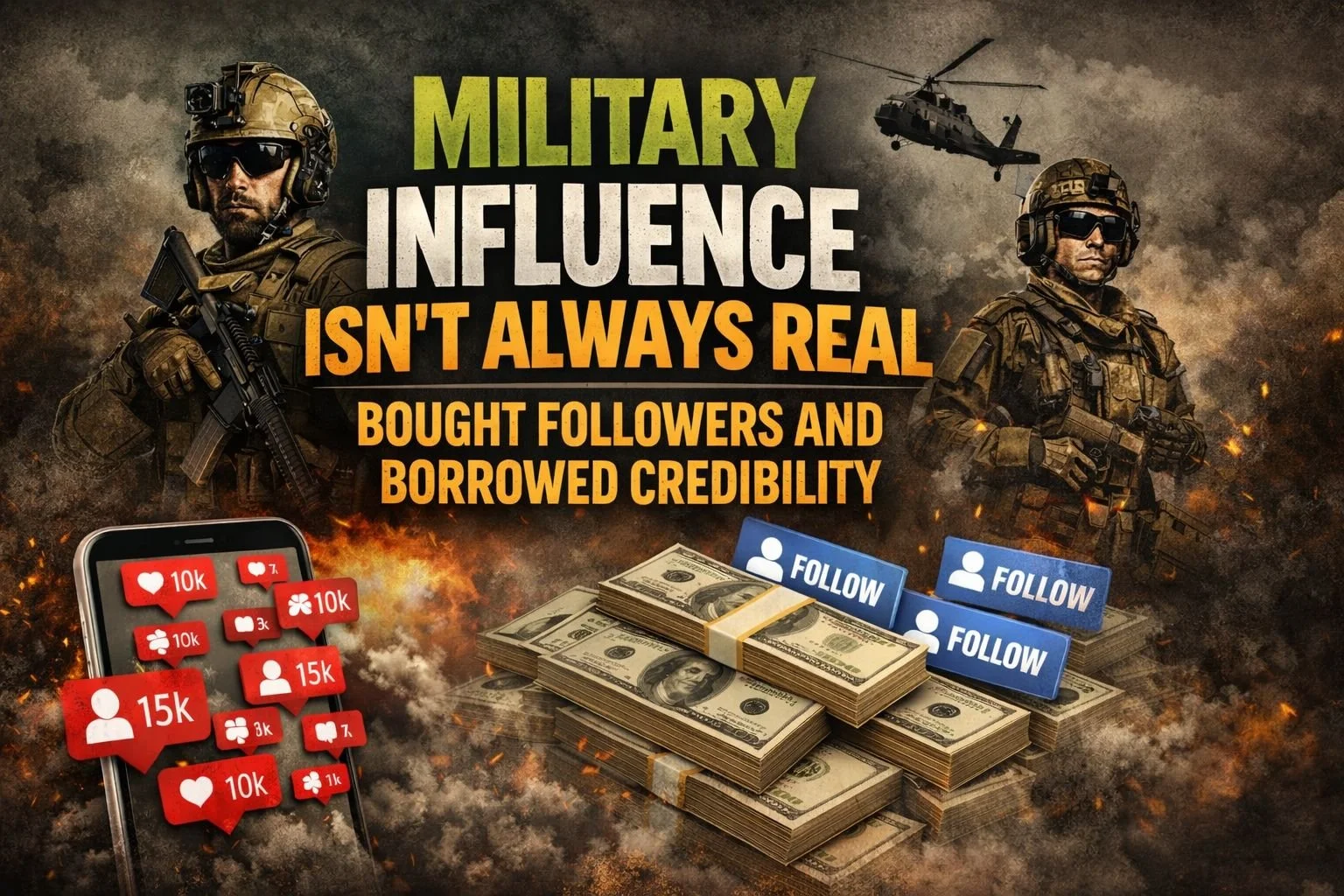
Military Metrics That Lie: Rethinking Influence and Credibility Online
“The internet is not real.”
That line landed harder than it should have.
A former guest said it to me casually while I was giving feedback on his podcast. But it stuck, because it is something my military friends and I talk about all the time when we get into the weird, glossy, deeply deceptive world of military influencer culture.
The truth is this space runs on illusion.
Big numbers. Big brands. Big credibility. Except sometimes the numbers are smoke, the brands are inflated, and the credibility is rented by the thousand.
Within the veteran community, especially on YouTube, Instagram, and TikTok, there have long been rumors that some of the biggest names padded their followings to look larger, louder, and more authoritative than they actually are. This is not conspiracy. It is a business model.
Statista reported that in 2021, roughly 49 percent of Instagram influencers engaged in follower fraud. Research I came across in 2025 shows the numbers have not meaningfully improved.
And here is the uncomfortable part. You do not have to be chasing internet fame to get pulled into it.
The moment you identify as a “creator” on Instagram or YouTube, the messages start coming. Foreign accounts promising explosive growth. Guaranteed followers. Brand elevation. All for a fee. I know this because early on, when I was trying to grow my reach, I almost fell for it. Instead, I clicked through the profiles they were offering to deliver.
What I saw was ridiculous.
Empty accounts. No real photos. No conversations. No humans. Just digital mannequins dressed up as influence.
Once you see it, you cannot unsee it.
Here are a few common tells that something is off.
Low engagement compared to follower count. Thousands of followers, but barely any real likes or comments
Comments that are shallow or generic. Hearts, fire emojis, “Nice post!” that have nothing to do with the content.
Sudden spikes in followers with no corresponding viral moment or media exposure.
Verification tools can help. Some charge, some do not. HypeAuditor is one example, but there are many. None are perfect, but patterns matter more than perfection.
The point is not to become paranoid. It is to become literate.
The internet rewards the appearance of authority, not always the substance of it. And in military spaces, where credibility actually matters, that should bother all of us.
Do your homework. Question big numbers. Look for real engagement, real community, real disagreement even. Manufactured consensus is a red flag.
Because what you see online is not always what is real.
And the only way not to get played is to stop assuming popularity equals truth.
Any other red flags you have noticed that signal fake followings or manufactured influence?
Don’t be a sucker.