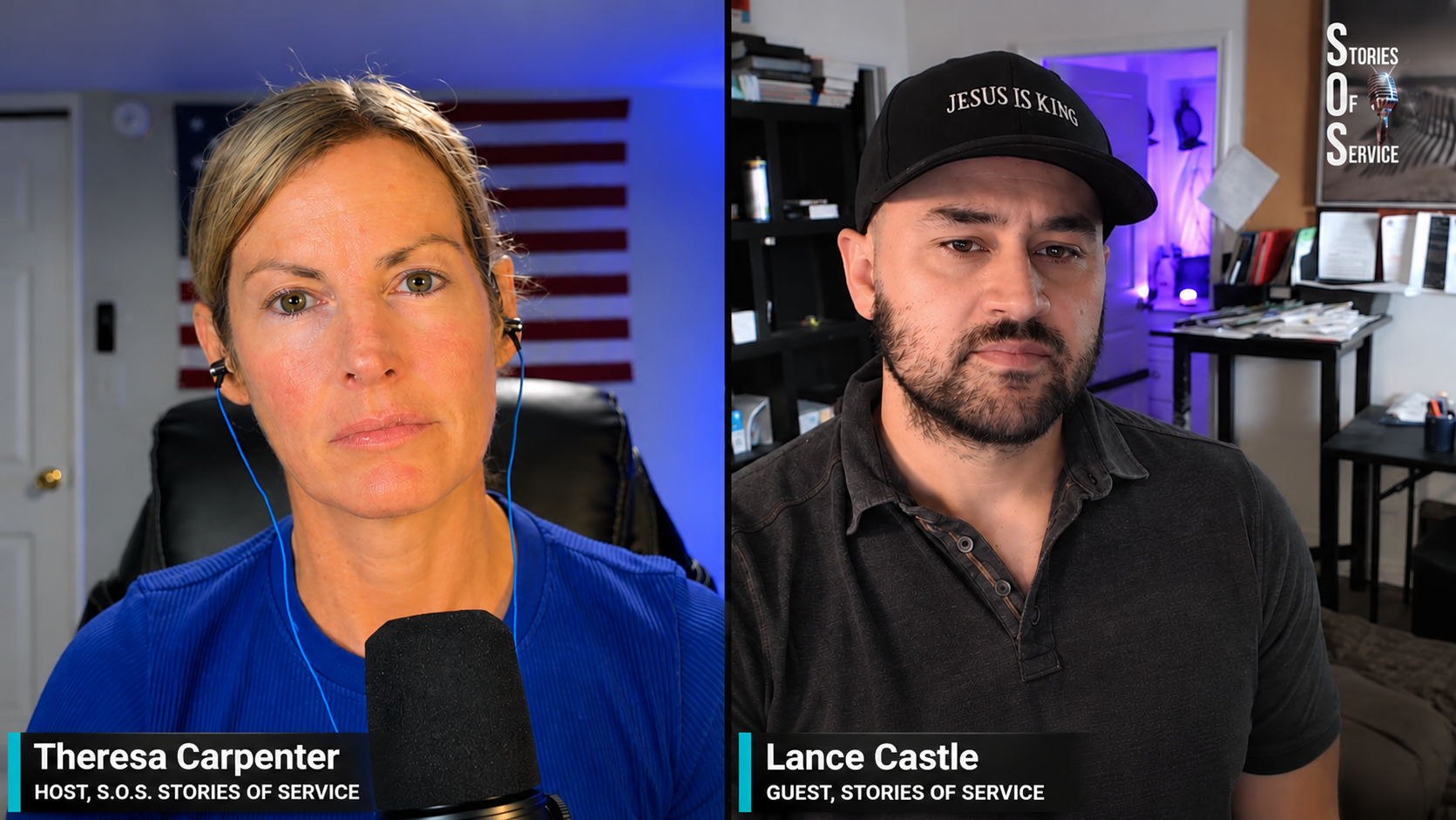
What happens when an acquittal does not bring an end to a service member’s conflict with military leadership? For Air Force Airman Lance Castle, the answer involves another court-martial, an appeal, and continuing questions about the treatment he received.
On Stories of Service, host Theresa Carpenter speaks with Castle about his military career and the events he believes changed its direction. Their conversation follows his account of disciplinary disputes, confinement, a first acquittal, and a later conviction. It also examines the personal consequences of challenging an institution while depending on that institution’s processes to resolve the dispute.

WHO IS LANCE CASTLE?
Castle describes growing up in a military family, beginning at Clark Air Base in the Philippines, where his father served. His childhood included moves through Japan, Guam, California, and Texas.
He joined the Air Force in 2005, initially pursuing pararescue training. He recalls completing several demanding training components and a paramedic program before moving into logistics after leaving the pipeline.
According to Castle, his earlier career included deployments and a positive service record. That history matters to his account because he contrasts it with the disciplinary problems that later came to define his relationship with his command.
The Vaccine Dispute and a Breakdown in Trust
Castle identifies his refusal of the COVID-19 vaccine as the turning point. He describes religious objections and says he became increasingly isolated as others in his unit accepted vaccination.
He connects subsequent disciplinary actions to that refusal, including orders, rebuttals, and a discharge recommendation. Those connections represent his interpretation of the events rather than independently established findings presented in this article.
The interview includes broader arguments about vaccine policy and legal authority. Its central personal story, however, concerns how Castle says his relationship with leadership deteriorated and why he began questioning the accuracy of official paperwork.
Why Documentation Became Central to His Case
One early dispute involved a performance evaluation. Castle says he challenged unfavorable markings by seeking information from the unit where he had worked and presenting that information to his leadership.
He reports that the evaluation was subsequently improved. For him, that experience reinforced the importance of checking statements against records rather than accepting an unfavorable account without questions.
As tensions continued, he says he began recording interactions and retaining correspondence. Throughout the interview, he returns to emails, personnel files, recordings, and testimony as materials he believes support his version of events and expose inconsistencies in official accounts.
The Insider Threat Allegation
Castle describes paperwork identifying him as an insider threat and linking that assessment to alleged radicalization following his vaccine refusal. He disputes the characterization and says investigators did not establish the extremist connections implied by it.
He also discusses later descriptions of him as a potential safety threat. In his account, these labels contributed to escalating action against him.
These are serious allegations about the creation and use of official records. Evaluating them requires the underlying documents and the relevant investigative context. The interview provides Castle’s explanation of why he believes those descriptions were unsupported and damaging.
Confinement and the Cell Extraction Video
The conversation includes discussion of Castle’s arrest in April 2023 and a video of a subsequent cell extraction. He describes the circumstances leading to the incident and disputes accounts portraying his behavior as threatening.
Castle alleges that force used during the extraction caused injuries, and he discusses treatment and concerns about his medical documentation. Carpenter acknowledges the difficulty of recounting an experience he describes as traumatic.
The footage is an important part of the episode, but the transcript alone cannot resolve every question about the incident. Castle’s allegations about injuries and inaccurate records remain attributed to his account.
The First Court-Martial and Acquittal
The interview describes Castle’s first court-martial as ending in acquittal in September 2023. He discusses allegations involving absence, disrespect, insubordination, and an assault accusation connected to the extraction.
Castle credits the first judge’s consideration of the surrounding circumstances. He says recordings and testimony challenged parts of the government’s presentation, including an allegation about words he supposedly directed at a commander.
An acquittal resolves the charges before that court; it does not independently prove every allegation Castle makes about other people. Carpenter makes a related distinction in her introduction, explaining that later charges must also be examined against their own evidence.
Why a Second Court-Martial Followed
Castle says returning to his previous command environment after the acquittal did not restore trust. He describes reassignment problems, unresolved security clearance issues, and continued disputes over records and treatment.
He identifies the second case as involving allegations of disrespect, absence without leave, and disobeying an order restricting social media activity. Although he describes similar charge categories, he acknowledges different specifications.
That distinction is essential to an accurate timeline. A second prosecution following an acquittal does not, by itself, establish that the same conduct was retried unlawfully. Castle’s broader argument is that the later events cannot fairly be understood without the earlier conflict.
WATCH FULL EPISODE HERE
The Appeal and Its Personal Costs
Castle says the second court-martial concluded in March 2025 with convictions. At the time of the interview, he describes being on unpaid appellate leave while challenging that outcome.
His account emphasizes consequences beyond the courtroom: difficulty finding employment, financial pressure, and concern that background records did not accurately reflect earlier outcomes. He describes trying to explain those differences to prospective employers.
Castle also discusses seeking civilian legal representation. His stated goals include succeeding on appeal, restoring rank and pay, and pursuing retirement and accountability. Those remain his objectives, rather than outcomes the interview establishes he will receive.
The interview also makes clear how much time this process demands. Castle describes reviewing documents, tracking inconsistencies, and explaining a complicated history while trying to maintain stability for his family.
Accountability and Trust in Military Justice
Carpenter frames the conversation around a balance: discipline is necessary, and so are integrity, reliable evidence, and fair treatment. Castle’s story gives those concerns a personal setting without resolving every disputed detail.
For listeners, the interview invites careful attention to chronology, records, allegations, and decisions. Supporting scrutiny means asking what the evidence shows while recognizing the human burden of a prolonged dispute. Watch or listen to Lance Castle’s conversation with Theresa Carpenter on Stories of Service for his account of the courts-martial, appeal, and continuing search for accountability.
Editor’s Note
This article summarizes Lance Castle’s interview. Allegations of retaliation, inaccurate records, and misconduct reflect his account and have not been independently verified for this article. Trial outcomes and appeal status are described as presented at the time of recording.
Learn More
👥 Connect with Stories of Service Podcast