I Will Never Stop Fighting for Caleb
“I want accountability to mean something”
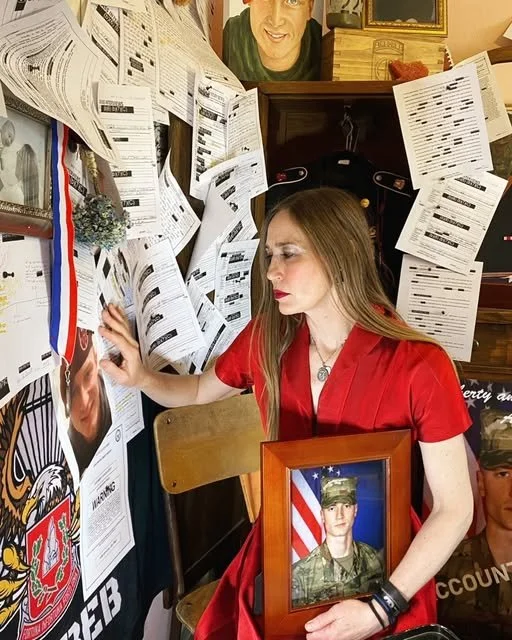
Look closely at the photo.
A woman in a red dress, sitting in a room papered floor to ceiling with documents. Black redaction bars run across nearly every line. Above her shoulder, a painted portrait of a young man. And in her lap, framed and held against her like something she will not put down, a photograph of a soldier in uniform.
That soldier is her son, Caleb.
Those papers are not decoration. They are six years of her life. CID investigations she read for ten hours straight the first time she opened them. Autopsy reports. Death scene photographs. Spreadsheets she built by hand to track every contradiction, every timeline, every page reference.
She calls it her journal.
Heather was a guest on Stories of Service, and her story has not left me since. She taught school for more than twenty years. She is a mother. And she is the most relentless investigator I have ever met - not by training, but because grief left her no other choice.
People keep asking her why she can't just move on.
Here is her answer, in her own words.
——————————————————————————————————————-
Redactions..
People ask me why I can’t just move on. They ask if I’ve tried grief therapy or journaling.
Sometimes I just want to say, “Go look at my Facebook, Instagram, and TikTok channel that has over 15,000 followers”
This is my journal.
Every post represents another step through a fire I never asked to walk through.
The first time I sat down to read Caleb’s CID investigation, it took me ten hours just to get through it. That was only the beginning. I immediately began analyzing every investigation, creating Excel spreadsheets documenting discrepancies, contradictions, timelines, and page references so I could quickly find and verify information.
I did all of that while teaching school that I worked at for over 20 years Lubbock ISD. My students, my administration, and the people around me, supported sustained me.
That work was eventually presented to my Congressman, Congressman Jodey Arrington, then to Senator Ted Cruz, and ultimately to the Secretary of the Army. Caleb’s case was reopened, and new Army accountability policy was written as a result.
But none of that changes what happened.
After Caleb died, I waited for his commander, Colonel Scotty Autin, to call me. A week went by. Nothing.
I was the one who finally started calling the Fort Bragg base operator asking who I needed to speak with about my son’s death. Only then did he contact me.
During that same week, I was being told it could take four weeks to bring Caleb home. I was planning an open casket funeral because no one had told me otherwise. Congressman Arrington stepped in and helped get Caleb home much sooner.
Then my casualty assistance officer called and said, “You may want to sit down.”
That was the moment I learned my son’s body had decomposed to the point that he could not be viewed.
Imagine planning to see your child one last time, only to have that taken from you.
I flew to Fort Bragg for Caleb’s memorial. Before the service, Colonel Auten walked me onto the base and told me he took the best care of his paratroopers and treated them like family.
I believed him.
Nine months later I received Caleb’s autopsy.
About a year later I received the CID investigation.
As I read the documents and continued my investigation, my understanding of what happened changed completely.
I also fought to obtain Caleb’s death scene photographs. When they were finally released to me, they were printed as small black and white images on standard paper. Yet the autopsy photographs were provided in full color on an encrypted disc.
I have often wondered why there was such a difference.
In the death scene photographs, I observed what appeared to be a large dark area beneath Caleb’s body. In the autopsy photographs, I observed what appeared to be dried blood on Caleb’s face, while a later photograph appeared different after that area had been cleaned.
Those observations have left me with questions that remain unresolved. Based on everything I have reviewed over the past six years, I still struggle to reconcile what I observed in those photographs with the conclusion that acute bacterial meningitis alone explains everything that happened.
I confronted Colonel Autin and told him nobody had physically checked on Caleb. He assured me I was wrong and said someone had.
Years later, the Secretary of the Army told me herself, point blank, that nobody had physically checked on my son.
When I shared that with members of Congress, including Senator Tom Cotton, they were surprised to learn that no action had been taken against the leadership responsible for Caleb’s accountability.
Since then, Colonel Autin has been promoted.
The independent contractor involved in Caleb’s care is still working at Womack Army Medical Center.
My son is still gone.
People ask if I’m bitter.
No.
I’m heartbroken.
People ask if I want revenge.
No.
I want leaders to do their duty.
I want accountability to mean something.
I want every commander to understand that the lives of the soldiers under their care are not just names on a roster. They are somebody’s son. Somebody’s daughter. Somebody’s entire world.
I can’t bring Caleb back.
But I can fight for the soldiers still serving.
I will never stop fighting for Caleb.
More importantly, I will never stop fighting for Caleb’s battle buddies.
The Smitty Check has never been about revenge. It has always been about making sure another family never has to endure what ours has endured.
That is what justice looks like to me.
—————————————————————————————————————
I reposted this because I have read enough military investigations now to know what it costs to keep reading them. The ten hours. The spreadsheets. The photographs you can never un-see. Most people would have closed the file and looked away. She turned her kitchen table into a war room instead, and her grief into policy - a reopened case, a new Army accountability standard, the Smitty Check.
But she is right about the part that matters most. None of it brings Caleb back.
What it can do is reach the next family before they ever have to learn this vocabulary: casualty assistance officer. Decomposition. Point blank.
A roster is not a list of names. Every line is somebody's son. Somebody's daughter. Somebody's entire world.
That is why I share her story, and it is why I will keep sharing the ones like it - until accountability stops being something grieving families have to fight for, and starts being something leaders simply do.
If Heather’s words moved you, do the one thing she has asked of all of us from the beginning.
Don't look away.